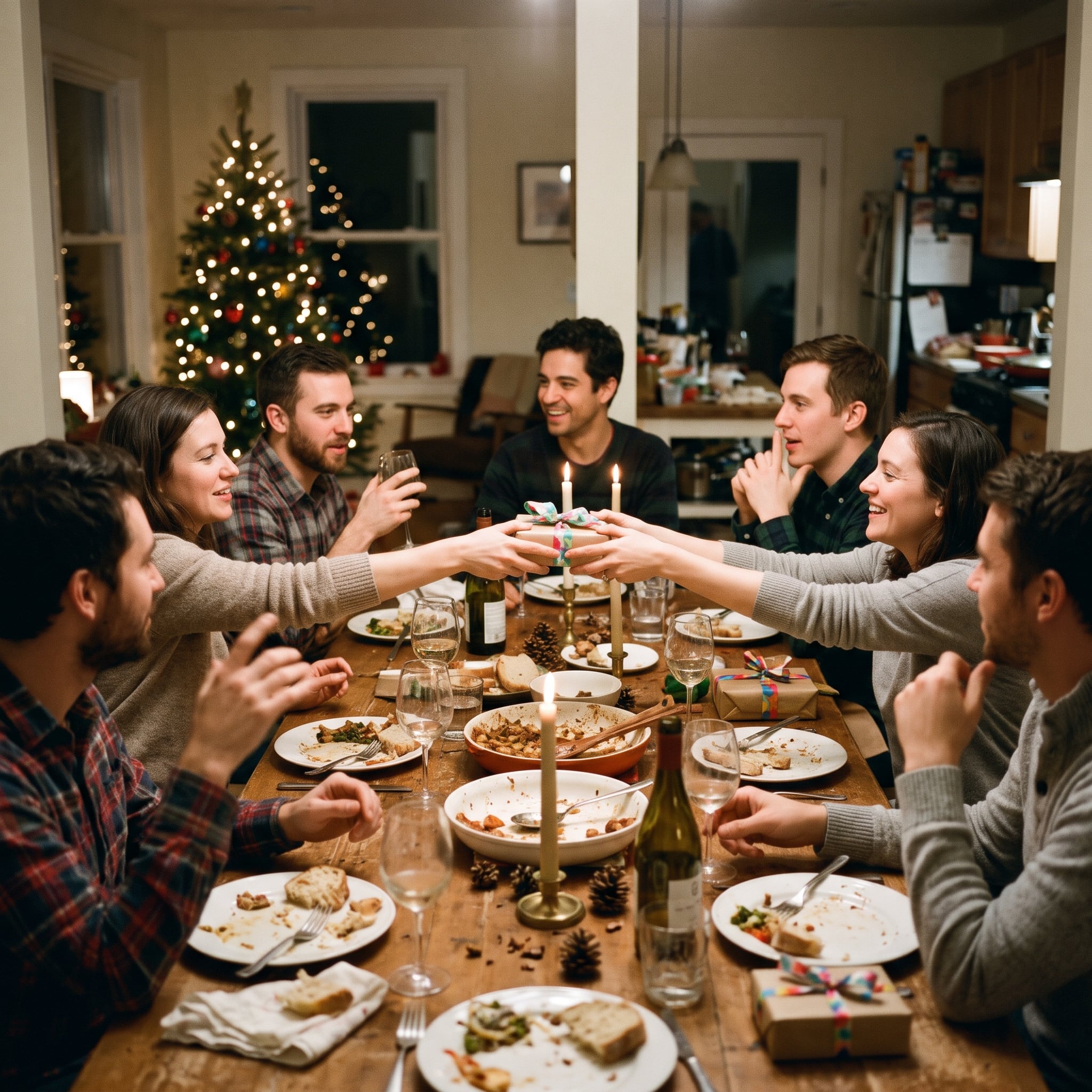
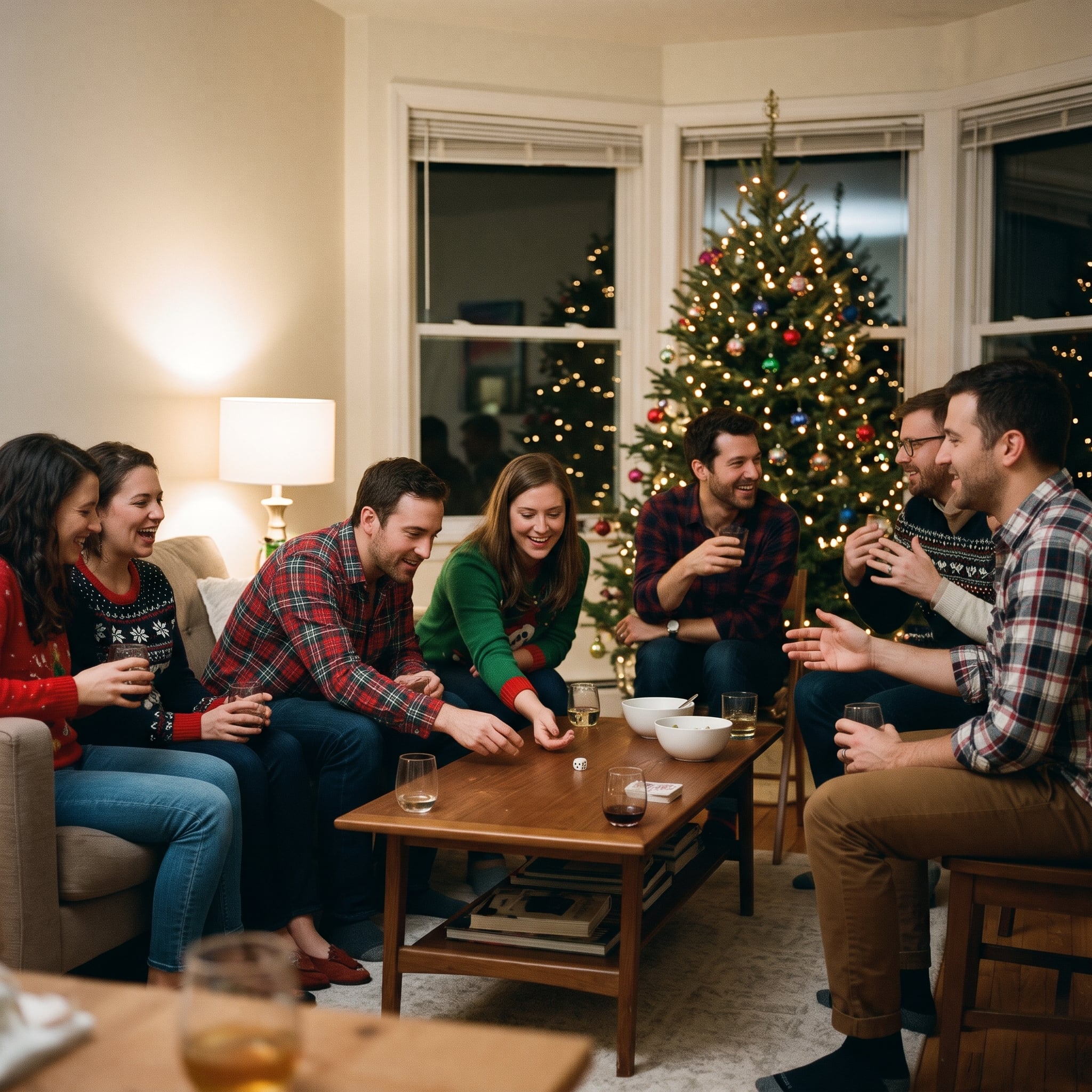
The first game is not necessarily the one people remember. It may be the round that finishes just as a late guest comes through the door, or the quick match that leaves enough time to clear the table before dinner. A Christmas gathering built around games has to account for all of those changes.
These Christmas game night ideas start with the structure of the evening rather than a list of titles to buy. The aim is to make it clear which game begins, how players rotate, where scores go, and when everyone can put the dice down. A living room with one table can host several kinds of play, but only if the equipment and timing make sense together.
Choose the three rounds you want before sending invitations. Then adjust the plan for the friends who actually arrive.
1. Count Players, Not Invitations
Eight confirmed guests do not guarantee eight active players. Two may want to watch the first round, another may be late, and somebody may be in the kitchen dealing with food. Ask who wants to play the opening game instead of automatically assigning everyone a seat.
For Christmas game night ideas at home, the useful number is the count of players ready for the next round. Write that figure at the top of a score sheet and change it between games, not halfway through a turn.
A simple RSVP message can ask guests to choose one of three preferences: mostly games, a mixture of games and conversation, or happy to watch and join occasionally. These are preferences, not permanent teams. They tell you whether a single long game is likely to suit the group. For Christmas game night ideas with mixed interests, that one answer can determine whether you need a second table or only a few extra chairs.
Set a maximum player count for each table before the night begins. If a game has six seats and eight volunteers, use two short sessions or let two people join the following round. Avoid stretching equipment beyond what the rules can support.
2. Christmas Game Night Ideas by Group Size
The table below is a planning guide, not a claim that every game supports every group. Check each game’s published or agreed house rules before assigning players.
| Active players | Recommended arrangement | First round | Main round |
| 2–4 | One compact table | Quick dice prediction | Hidden-dice duel or short strategy game |
| 5–6 | One table with clear sightlines | Shared-roll challenge | Dice or card game with visible turns |
| 7–10 | Two teams or rotating chairs | Simultaneous guesses | Team drawing or short station rounds |
| 11–16 | Two smaller activity areas | Drop-in observation challenge | Parallel games with separate scores |
For a group of four, a single dice cup can circulate without creating long breaks. With ten players, the same cup may leave people waiting through nine turns. This is where Christmas game night ideas should become an equipment decision: divide the group, use simultaneous guessing, or select another mechanic.
If one game can accommodate only two players, put its table where friends can watch without blocking the doorway. A spectator-friendly duel adds a different kind of activity, but it should not become the only thing happening in a room of twelve.
When the Guest List Changes
If two more people accept the invitation, check the table capacity before adding chairs. A second score sheet and a small side table may be more helpful than two extra place settings crowded around the same game.
3. Give Each Game a Different Job
Three games with identical turn patterns can make a long night feel like one extended round. Assign each part of the evening a purpose instead.
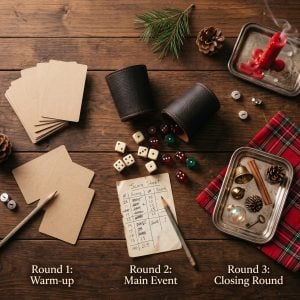
Opening round — 5 to 10 minutes. Use a shared roll, prediction, or brief guessing activity. Nobody should need to remember scores from before they arrived.
Main game — 20 to 35 minutes. Choose the format people came to play: a bluffing duel, a compact dice competition, or a team challenge. Tell participants the winning condition before the first turn.
Closing round — 10 to 15 minutes. Use something that can finish cleanly, even if a few friends have already left. A shorter rematch or a final team challenge works better than launching a complicated new ruleset.
This three-part design gives Christmas game night ideas a useful order. The opening activity tests who wants to play. The main round gives the group a common focus. The closing round provides an ending without needing a formal awards ceremony.
For playable rules and player counts, use Christmas Party Games for Adults. It includes Five-Dice Forecast, Holiday Bunco Sprint, Wrapped Gift Bluff, December Drawing Relay, and other complete house-rule games. This article focuses on arranging those games, so their full instructions do not need to be repeated here.
Choose a Backup by Mechanic
If the planned main game uses hidden dice, prepare a backup with visible rolls or team answers. A second bluffing format is not much help if the group has decided it dislikes bluffing. When comparing Christmas game night ideas, put one team-based backup beside an individual-turn main game so the group has a genuine alternative.
4. Make the Scoreboard Easy to Understand
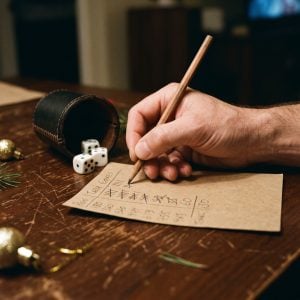
A score sheet needs more than player names. Write the game, round number, point target or number of rounds, and how a tie will be handled.
For a six-player session, one page with six names and four round columns is usually sufficient. Put a pen beside it, not in another room. Ask one person to record scores and another to check disputed results, if necessary.
Here is a reusable layout:
| Player or team | Round 1 | Round 2 | Round 3 | Total |
| Team Red | — | — | — | — |
| Team Green | — | — | — | — |
The blanks are intentional; fill in the scoring method from the game actually being played. Do not combine points from unrelated games unless everyone has agreed on an overall contest beforehand.
Some Christmas game night ideas involve different winners across the evening. Treating every game as a new match allows late guests to join without inheriting a deficit. If you want an overall champion, award one match point per game won and post that rule before the opening round. That keeps Christmas game night ideas with different scoring scales from turning into an unfair combined leaderboard.
Decide on Ties Before Play
Use the tiebreaker given in the chosen game’s rules. If the rules declare a shared win, keep it. Inventing a bonus challenge after seeing the leaders can make the outcome feel arbitrary.
5. Give the Table Enough Space to Function
Test the table with the real equipment, not just the Christmas centerpiece. Two dice cups need room to stay hidden from the opponent. A shared score sheet needs a dry corner. A drawing game needs a surface everyone on the team can see.
Divide the main table into three practical areas: play in the center, scorekeeping at one edge, and personal glasses or snacks along the outer corners. Put fragile ornaments and electrical cords somewhere else.
For Christmas game night ideas in a small apartment, one table may change jobs. Use it for finger food during arrivals, clear it before the main game, then bring dessert back afterward. Keep a tray ready so the transition takes minutes rather than requiring guests to find somewhere for every plate.
Party Host Tip: Sit in the farthest chair and check whether you can read the dice and score sheet. If a player would need to stand up to see a roll, adjust the table light or seating before guests arrive.
For Christmas game night ideas involving two formats, set aside a labeled tray for the second game; its dice or cards should not be scattered among the first game’s pieces. You can browse Party Night Games for ready-made bundles, then arrange the table around the specific components you choose.
6. Christmas Game Night Ideas for a Two-Hour Gathering
Two hours leave room for a proper main game, but not for three long competitions and a full meal. Choose food that does not stop the session.
| Time | What happens | Equipment or host action |
| 7:00-7:15 | Arrivals and optional prediction round | One dice cup and scorecard already on the table |
| 7:15–7:30 | Snacks and rule explanation | Clear the game surface; confirm active players |
| 7:30–8:05 | Main game | Record the agreed number of rounds |
| 8:05–8:20 | Break and drinks | Put away the first game’s pieces |
| 8:20–8:45 | Closing game or rematch | Begin with a fresh score |
| 8:45–9:00 | Dessert and open conversation | No additional compulsory activity |
This is one example, not a fixed timetable. For Christmas game night ideas built into a short after-work visit, a ten-minute buffer is valuable when people arrive late or need to move furniture.
Choose the main game first, then fit the opening and closing activities around it. If food takes longer than expected, shorten the optional rematch rather than the match everybody came to play.
7. Expand to Three or Four Hours Without Adding More Rules
Longer does not mean more games. A three-hour session can use the same three rounds with a meal and a longer break between the main and closing game. A four-hour party can add a second table for people who want different levels of competition.
Three-hour arrangement: Allow 30 minutes for arrivals and food, 10 minutes for a short opener, 40 minutes for a main match, 20 minutes away from the table, 30 minutes for a second format, and the remainder for snacks, conversation, and departures.
Four-hour arrangement: Start with an optional activity during arrivals. Serve the main food before the longest match. Afterward, open two smaller stations for about 30 minutes; close with one shared challenge only if enough guests want it.
The advantage of these Christmas game night ideas is that the schedule contains places where nothing needs to be announced. A guest who wants to watch for half an hour should not derail the plan. For Christmas game night ideas spanning four hours, mark the last game as optional so a late meal does not force an awkward cut to the main match.
When a Match Runs Over
Agree in advance whether the game ends after a number of rounds or when someone reaches a stated score. If the announced finish has not been reached, continue or ask the players to agree to stop; do not silently change the target because dessert is ready.
8. Rotate Players Without Rewarding the Fastest Arrivals
Rotation can be simple without becoming a tournament bracket.
For a two-player duel with six interested guests, write their names in arrival order. The first pair plays one complete match; then both players move to the end of the queue, regardless of who won. This guarantees everyone a chance before anyone receives an immediate rematch.
If the group prefers a winner-stays format, announce it in advance and cap each player’s consecutive matches at two. Spectators should know when their turn is expected. For Christmas game night ideas with a visible queue, write the next two names on a card beside the cups so players can see who follows.
For Christmas game night ideas involving two tables, separate the game stations by type. One can support a bluffing game while the other holds a group prediction or drawing activity. Keep the score sheets at the tables so results do not get mixed up during rotations.
Make Joining and Leaving Routine
Late arrivals enter at the next fresh round. A player stepping out mid-match can return for the following match, while the current game’s published rules decide whether a substitute or restart is appropriate.
Avoid moving someone from a leading team to a losing team simply to make the room appear balanced. Reset teams between matches instead.

9. Let Food, Drinks, and Light Serve the Games
Finger foods work better near shared cards and dice when guests can pick up a bite between turns. Keep sauces, oily snacks, and open serving bowls away from the rolling area. Put water within reach and use a tray for used dishes so the table can return to play quickly.
If your Christmas game night ideas include a drink-related kit, make beverages optional and independent of scoring. Cups can hold non-alcoholic drinks, counters, or candy. Do not turn losing into a requirement to drink alcohol.
Lighting is a practical choice too. Decorative Christmas lights can define the background, but players must be able to read a card and see all dice faces. Use a table lamp for the active area, keeping wiring away from feet and spilled drinks.
Set One Photo Moment
Take pictures between matches rather than during a hidden-dice roll. A pause after the main game gives friends an opportunity for a group photo without disturbing anyone’s turn. In Christmas game night ideas with hidden dice or private cards, this also prevents a camera from accidentally showing information that should remain concealed.
If the room already has a tree and warm window lighting, more decorations may not improve it. Leave the game surface open.
10. Match Kits to the Stations You Actually Plan to Run
A product is useful when its contents fit a chosen game. A large bundle is unnecessary if only one table will be active, while a two-player hidden-dice format cannot operate as intended with only one opaque cup.
| Station | Required parts | Relevant product |
| Short dice opener | Numbered dice, score paper | The Classic Strategy Dice Set |
| Three-dice table | Three dice, cup, score sheet | The Social Bunco Party Pack |
| Head-to-head bluff table | Two cups, ten dice | The Bluff and Duel Dice Kit |
| Two simultaneous dice groups | Enough dice and cups for both formats | Compare Adult Party Games options |
The Bluff and Duel set includes two cups and ten dice; the Social Bunco pack includes three dice and a cup. Choose based on the exact activity rather than assuming one kit runs every format.
For Christmas game night ideas that use existing market-ready products, buying separate completed sets or combining stocked components is more practical than commissioning new custom printed cards. Check the current components on each product page before deciding how many stations you can support.
Featured Pick: For a four-person group that likes bluffing, two opaque cups and ten dice create one duel table with spectators rotating in. If everyone wants to roll together, a different format—or additional sets—will be needed.
11. Fix the Problems That Interrupt a Round
Prepare a decision for common interruptions before somebody has a score worth defending.
| Problem | Pre-agreed response |
| A die lands against the cup | Reroll only the die that did not settle flat |
| A guest arrives after scoring starts | Add them at the next fresh match |
| The score sheet is damaged | Reconstruct scores only if players agree; otherwise restart the disputed round |
| Two teams finish tied | Follow the game’s stated tiebreaker or record a shared win |
| Someone opts out | Let them watch or leave; don’t pressure them to play |
| The main game ends early | Offer the prepared backup rather than inventing new rules |
An effective host makes these decisions before the results are known. In Christmas game night ideas centered on friendly competition, consistency matters more than a dramatic tiebreaker.
Keep an extra pen, dry score sheet, spare dice, and a small container for loose pieces nearby. That kit may save more time than preparing a fourth game no one is likely to play.
Frequently Asked Questions About Christmas Game Night Ideas
How many games fit into a Christmas game night?
For two hours, one short opener, one substantial game, and an optional closer are realistic. A longer gathering can include breaks or a second table instead of adding a new game every twenty minutes.
What Christmas game night ideas work for four adults?
A shared-roll prediction, Holiday Bunco Sprint, or a rotating hidden-dice duel suits a small group. Pick one as the main match and use another as a quick warm-up rather than running all three back to back.
How do you organize a game night for ten or more friends?
Split players into two teams or use two stations with separate score sheets. Choose games with known round lengths and fresh starting scores so late arrivals can join between matches.
Should the host keep an overall score for every game?
Only if everyone agrees before starting. Games with different scoring scales are difficult to combine fairly; giving one match point to each game winner is a simpler optional approach.
Can we use drinking game kits without alcohol?
Yes. Dice cups, illuminated cups, and shot glasses can serve as game components or hold counters. The rules can award points without making anybody drink.
What if some friends only want to watch?
Leave a clear viewing spot and rotate participants at stated match boundaries. An optional game station should not become a reason to exclude guests from conversation or food.
End With a Final Score, Not Another Explanation
The last match should be easy to recognize as the last match. Announce its round limit at the beginning, leave the score where everyone can see it, and pack the pieces once the result has been confirmed.
That is the practical value of Christmas game night ideas built around a sequence: players know where to sit, how to join, when a new score begins, and when the table is free again.
The Christmas decorations can stay in the background. The games have already given the evening its shape.