A wrapped box can sit beside the dice cup without becoming part of a gift exchange. Eight handwritten cards can occupy less space than a dinner plate. And three dice can keep four friends busy long after the dessert dishes have disappeared.
The equipment for a holiday game night is rarely complicated. The harder part is choosing rules that fit the people around the table.
These Christmas party games for adults offer seven playable formats, from quick predictions and conversation cards to memory challenges and hidden-dice duels. Each includes the number of players, necessary supplies, turn sequence, and a defined finish. The rules are complete enough to use without inventing a scoring system halfway through the evening.
The Christmas-themed games and adaptations in this guide are presented as house rules, not as official instructions for branded games. Alcohol, wagering, and purchased gifts are not required.
How to Choose Christmas Party Games for Adults by Player Count
Before opening a game box, count the people who actually want to play. A table with four active players needs different rules from a room with twelve guests, six of whom may prefer watching.
| Game | Players | Equipment | Approximate playing time | Main skill |
| Five-Dice Forecast | 2–8 | Five dice, score sheet | 5–10 min | Prediction |
| Stocking Secrets | 3–10 | Prompt cards, paper, pens | 10–15 min | Reading other players |
| Holiday Bunco Sprint | 3–4 | Three dice, dice cup | 10–15 min | Luck and scoring |
| Wrapped Gift Bluff | 2 per duel; rotating group | Ten dice, two cups | 15–20 min | Bluffing |
| December Drawing Relay | 4–12 | Paper, pens, prompt cards | 15–20 min | Team communication |
| Christmas Memory Tray | 3–12 | Tray, 12 objects, paper | 10–15 min | Observation |
| Snowflake Code | 3–8 | Two dice, opaque cup | 10–15 min | Deduction |
Playing times are estimates for groups familiar with the rules. Add a few minutes for the first demonstration.
For Christmas party games for adults, it helps to match the equipment to the activity rather than buying a larger bundle simply because more items are included. Five regular dice can support several games; a two-cup set becomes useful when opponents need to conceal separate rolls.
Game 1 — Five-Dice Forecast: A Prediction Game
Players: 2–8
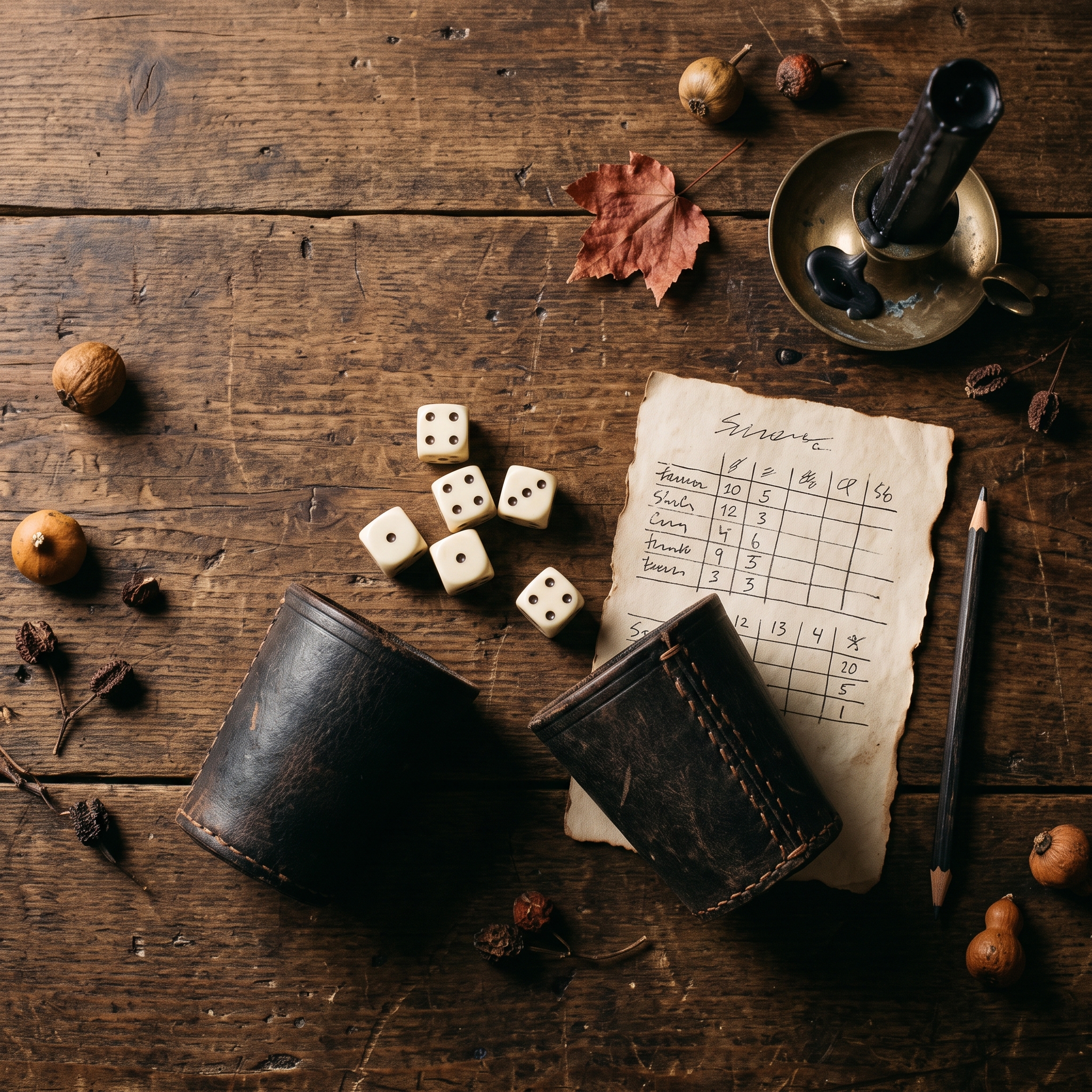
Equipment: Five standard dice, one score sheet, optional dice cup
Goal: Finish five rounds with the most correct predictions
For the opening round, everyone watches the same roll rather than taking separate turns.
How to Play
- Before rolling, every player predicts how many sixes will appear among five dice. Any prediction from zero to five is allowed.
- The roller shakes and releases all five dice.
- Count the dice showing six.
- Each player whose prediction is correct earns one point.
- Rotate the roller clockwise and repeat until five rounds have been completed.
Players may choose the same prediction.
Example
The dice show 6, 6, 4, 2, 1.
The result contains two sixes. Anyone who predicted two receives a point; everyone else receives zero.
After five rounds, the highest score wins. If players tie for first place, they make another prediction and watch a bonus roll. Repeat as needed until one player wins that round.
What to Prepare
One dice cup and five regular dice are enough. You can use the same equipment for another game afterward, making this one of the more economical Christmas party games for adults for hosts who already own standard dice.
Game 2 — Stocking Secrets: Guess What Your Friends Would Choose
Players: 3–10
Equipment: Eight homemade prompt cards, slips of paper, pens
Goal: Score the most correct guesses about other players
Stocking Secrets is a Christmas-themed guessing game. It works without personal questions or embarrassing challenges.
Prepare eight cards with two-option prompts. For example:
| Card | Question |
| 1 | Open a gift early or save every gift for Christmas morning? |
| 2 | Host the holiday dinner or wash every dish afterward? |
| 3 | Spend December in a snowy cabin or a warm beach house? |
| 4 | Receive a surprise gift or choose your own? |
| 5 | Watch one holiday film repeatedly or try a different film every night? |
| 6 | Decorate the tree alone or let everyone add ornaments? |
| 7 | Wear an outrageous Christmas sweater or a formal holiday outfit? |
| 8 | Make dessert or be responsible for the playlist? |
How to Play
- Select one player as the Secret Keeper for the first round.
- The Secret Keeper reads a card and privately writes down their choice: A or B.
- Everyone else writes which option they think the Secret Keeper chose.
- Reveal the actual choice.
- Each correct guess earns one point.
- Move the Secret Keeper role clockwise and draw the next card.
Play eight rounds. If you have fewer than eight players, some people will become Secret Keeper more than once.
The highest point total wins. If tied, ask one additional two-option question and let a player who is not tied act as Secret Keeper. If everyone is tied, choose one Secret Keeper by drawing lots and let the others guess.
Make It Work With Physical Cards
Handwritten prompts are sufficient. If you already own reusable social challenge cards, select suitable two-option questions and use the same scoring method.
For more conversation-led formats, explore Icebreaker Games That Actually Get People Talking.
Stocking Secrets works well among Christmas party games for adults when guests enjoy conversation but do not want their personal stories turned into public challenges.
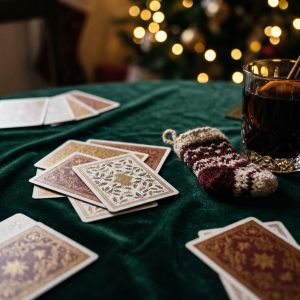
Game 3 — Holiday Bunco Sprint: Three Dice, Three Targets
Players: 3–4
Equipment: Three dice, one dice cup, score sheet
Goal: Earn the most points across three numbered rounds
This is a simplified holiday house variation inspired by Bunco. It is not presented as the complete traditional Bunco ruleset.
The idea is to roll dice that match the target number for the current round.
How to Play
The game has three rounds:
- Round 1 targets ones.
- Round 2 targets twos.
- Round 3 targets threes.
During each round, every player gets two turns. On each turn, roll all three dice once.
Score one point for each die matching the target number. If all three dice match the target, award five points for that roll instead of three.
Record the points and pass the dice.
Example
The target is two.
On the first turn, Ava rolls 2, 2, 5 and scores two points.
On her second turn, she rolls 2, 2, 2 and scores five points.
Her Round 2 total is seven.
After all three rounds, add each player’s points. The highest total wins. Tied leaders roll three dice once more with a target of three; the higher score wins. Repeat if necessary.
Which Set Fits This Game?
The Social Bunco Party Pack provides a dice cup and three dice, plus a six-cup Rainbow Shot Glass Set that can serve as scoring accessories or holders for small counters.
The cups are optional for these rules; a paper score sheet works equally well.
For hosts comparing Christmas party games for adults with only three or four active players, this format has a useful advantage: each turn uses the same three dice, so there is no need to distribute a set to every guest.

Game 4 — Wrapped Gift Bluff: A Hidden-Dice Duel
Players: Two per duel; three or four can rotate through matches
Equipment: Two opaque dice cups, ten standard dice
Goal: Win three successful challenges or defenses
In this game, two players each hide five dice beneath a cup. Both must make claims about how many dice of a particular value exist across their combined ten dice.
The Christmas-themed name is an original house-rule label. The mechanic is a simplified hidden-dice bidding game.
Preparing the Duel
Each player receives five dice and an opaque cup.
Roll privately. Keep all five results hidden from your opponent. Players may inspect their own dice at any time during the duel but may not change them.
How to Play
- The starting player makes a bid, such as “three fours.” This claims that at least three of the ten hidden dice show four.
- The opponent must either make a higher bid or challenge the current claim.
- To raise a bid, increase the quantity, or keep the same quantity and name a higher face value. For example, “three fives” or “four twos” can follow “three fours.”
- A bid can never exceed ten dice.
- When someone challenges, both players reveal their dice.
- Count the dice showing the face value in the last bid.
If the count meets or exceeds the bid, the bidder wins one duel point. Otherwise, the challenger earns one point.
There are no wild dice in this version.
Example
One player bids “four threes.”
Their opponent challenges.
After revealing all ten dice, only three show the number three. The challenge succeeds, and the challenger receives one point.
Both players reroll privately for the next duel. Alternate the starting bidder.
The first player to earn three points wins the match.
For three or four people, the match winner stays and the next challenger takes the empty seat. Reset both players’ scores to zero for every new match.
Equipment Match
The Bluff and Duel Dice Kit includes two dice cups and ten dice, matching this two-player equipment requirement.
This is a different type of play from Holiday Bunco Sprint. Bluffing requires hidden results and a decision about whether to believe the opponent.
Within Christmas party games for adults, this format is better suited to guests who enjoy reading expressions and making calculated challenges than to groups looking for constant simultaneous participation.

Game 5 — December Drawing Relay: A Team Game Without Trivia Knowledge
Players: 4–12
Equipment: Paper, pens, a timer, 12 holiday phrase cards
Goal: Be the team with the most correctly guessed phrases
Divide the group into two teams of similar size.
Prepare twelve cards with drawable Christmas or winter phrases. Avoid references that only one friend group would recognize.
Suggested cards include:
- A reindeer tangled in string lights
- A snowman holding an umbrella
- A gift hidden behind the sofa
- A gingerbread house with a broken roof
- A Christmas tree too tall for the room
- A stocking full of oranges
- A cat sleeping under the tree
- A sleigh missing one runner
- A wreath hanging upside down
- A suitcase packed for a snowy trip
- A mug spilling hot chocolate
- A scarf caught in a door
How to Play
- Team A sends one player to draw a card without showing teammates.
- That player has 60 seconds to draw the phrase.
- They may not speak, write letters or numbers, or act out the answer.
- If the team guesses the full phrase within the limit, it earns one point.
- Team B then takes its turn using a different card.
Each team completes six turns. Rotate the artist so nobody draws more than twice unless the team has fewer than three players.
The team with more correct guesses wins.
If the scores tie, give each team one additional phrase from a new card. Continue until one team scores and the other does not in the same pair of turns.
What Makes the Relay Different?
A guessing game can be played with almost no purchased equipment. However, a set of reusable challenge cards becomes helpful when the host wants to avoid preparing prompts for every session.
This type of Christmas party games for adults also gives larger groups a format in which teammates can shout suggestions together rather than waiting for individual dice turns.
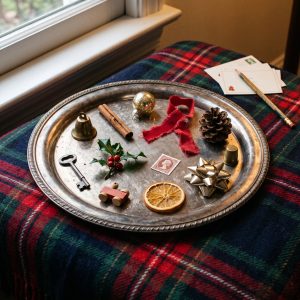
Game 6 — Christmas Memory Tray: Twelve Objects, Twenty Seconds
Players: 3–12
Equipment: A tray, 12 small objects, a cloth, paper and pens
Goal: Recall the greatest number of displayed objects
This game tests observation rather than Christmas trivia knowledge.
Choose twelve safe, recognizable items. They can be holiday objects or everyday household items.
For example: a ribbon, spoon, candy cane, key, ornament, coaster, playing card, pinecone, small bell, bottle cap, coin, and folded napkin.
Keep sharp or breakable objects away from crowded playing areas.
How to Play
- Arrange the twelve objects on the tray.
- Let every player study them for 20 seconds.
- Cover the tray completely.
- Give players one minute to write down as many objects as they remember.
- Reveal the tray and check the answers.
Award one point per correctly identified item. Do not give points for descriptions that cannot clearly identify an object.
The highest score wins.
If several players tie, remove two objects and add two different items, then conduct another 20-second viewing round for the tied players only.
A More Challenging Second Round
After everyone has played once, you may change the objects’ positions and remove one without announcing which one was taken away.
Ask players to name only the missing object.
Give one point for the correct answer. Treat this as a separate bonus challenge, not part of the original scoring unless all players agree beforehand.
Among Christmas party games for adults, the Memory Tray is useful when guests prefer a short observational activity rather than a competitive table game with several rounds of rules.
Game 7 — Snowflake Code: Guess the Hidden Dice Total
Players: 3–8
Equipment: Two six-sided dice, opaque cup, score sheet
Goal: Collect the most points from six hidden-code rounds
A pair of dice becomes the hidden code.
The person controlling the cup knows the sum. The other players must narrow it down using limited guesses.
How to Play
- Choose one Code Keeper.
- The Code Keeper rolls two dice privately, checks their sum, and covers them.
- They announce whether the total is odd or even.
- Each other player writes one guess between 2 and 12.
- The Code Keeper reveals whether each guess is higher than, lower than, or equal to the hidden total.
- Players who were incorrect may make a second guess.
- Reveal the dice after the second guessing stage.
A correct first guess earns two points. A correct second guess earns one point. An incorrect guess earns zero.
Rotate the Code Keeper clockwise. Play six rounds, using the next player in rotation as Code Keeper for each round.
The player with the highest total wins. In a tie, tied players make one additional guess against a new hidden roll controlled by a player who is not tied; the closest guess wins, with exact matches taking priority. If everyone is tied, choose the Code Keeper by lot and repeat until there is an outright winner.
Example Round
The Code Keeper rolls 4 and 5. The hidden total is nine, so the clue is “odd.”
Ben guesses seven. The Code Keeper says his guess is lower than the total.
Ben’s second guess is nine, earning one point.
The Code Keeper does not reveal individual dice during the guessing stages.
Why It Works With Basic Equipment
Snowflake Code needs only two dice and something opaque to hide the result.
The Classic Strategy Dice Set is one existing option for hosts who want reusable numbered dice and a dice cup.
It adds a deduction-based choice to these Christmas party games for adults, rather than relying solely on speed, drawing, or chance.
Which Christmas Party Games for Adults Need a Kit?
Not every activity benefits from additional equipment.
The important question is whether a kit provides components that would otherwise be missing or difficult to organize.
| Game | Minimum supplies | Relevant EZPartyStore option |
| Five-Dice Forecast | Five standard dice | Adult Dice Party Games Kit |
| Stocking Secrets | Homemade cards and pens | Social or challenge card products, if their prompts suit the rules |
| Holiday Bunco Sprint | Three dice | Social Bunco Party Pack |
| Wrapped Gift Bluff | Two opaque cups, ten dice | Bluff and Duel Dice Kit |
| December Drawing Relay | Paper and timer | No kit necessary |
| Christmas Memory Tray | Twelve household items | No kit necessary |
| Snowflake Code | Two dice and cup | Classic Strategy Dice Set |
For the dice-based formats, compare the listed quantities before purchasing. A single-cup set is sufficient for an open roll but cannot provide the separate hidden hands needed for Wrapped Gift Bluff.
If you want several players rolling at once, the Adult Dice Party Games Kit is another option to examine. Check the product’s current component list before assuming it supports a particular arrangement.
The broader Adult Party Games category provides additional ways to compare game equipment by format.
The product recommendations here are based on the components required for the rules, not on claims that one product has been independently tested against the others.
Check the Components Before Christmas Game Night
A short equipment check can prevent most interruptions.
Count the dice. Make sure cups conceal the results in hidden-dice games. Check whether any card prompts are incomplete or difficult to read. Test pens and put extra score paper within reach.
For Christmas party games for adults, it is also worth checking the physical space needed for each format.
A drawing relay requires a surface where teammates can see the sketch. Hidden-dice players need privacy for their rolls. Memory Tray needs a viewing position where every participant sees the same objects.
If multiple games will run simultaneously, separate their score sheets and equipment into individual bags or trays.
When Guests Join Mid-Game
Do not rewrite existing points.
Let the new player join the next fresh match or round. In team games, rebalance the teams at the next turn rather than interrupting someone already drawing or making a bid.
When the Game Takes Too Long
Use a shorter predefined finish.
A five-round prediction game can end after three rounds if the group agrees before starting. A hidden-dice match can be shortened from three duel points to two.
Avoid changing the finish only after one player has taken the lead.
Frequently Asked Questions About Christmas Party Games for Adults
What Christmas games work with four adults?
Holiday Bunco Sprint, Stocking Secrets, Five-Dice Forecast, and Snowflake Code can all be played with four people. For a more competitive evening, use two-player Wrapped Gift Bluff matches and rotate the opponents.
Can Christmas party games for adults be played without alcohol?
Yes. None of the seven games requires alcohol. Dice cups, shot glasses, and tokens can be used for rolling, scoring, or holding small objects without drinking penalties.
Which game needs the fewest supplies?
Snowflake Code needs two dice and an opaque cup. December Drawing Relay needs paper, a pen, a timer, and prepared phrases.
What is a good game for ten or more guests?
December Drawing Relay and Christmas Memory Tray accommodate larger groups without requiring everyone to take a long individual turn.
Can I use regular dice rather than Christmas-themed dice?
Yes. Standard numbered six-sided dice work for all the dice games described here. The holiday theme comes from the rules, prompts, and game names rather than specialty dice.
How many games should I prepare for one gathering?
Choose one shorter option and one longer option, then keep another ready in case the group wants a different format. The number of games you prepare does not have to equal the number you actually play.
Pick the Game Before You Pick the Accessories
The seven games above offer different kinds of participation.
Five-Dice Forecast starts with a single shared roll. Stocking Secrets rewards people who can anticipate their friends’ choices. Holiday Bunco Sprint provides quick scoring, while Wrapped Gift Bluff gives two opponents a reason to question each other’s claims. Drawing, memory, and deduction games cover groups that want less emphasis on dice.
Select the mechanics your guests will enjoy, then gather the equipment that those rules actually require.
These Christmas party games for adults can be played with homemade prompts, ordinary dice, and common household objects. Where a dedicated kit saves preparation or supplies a missing component, choose one based on the number of players and the rules you intend to use.
For the broader holiday hosting plan—including room layout, food timing, decorations, and game placement—continue to Christmas Party Ideas for Adults in our Party Ideas section.
The game itself should be the part you have already figured out before the first player picks up the dice.