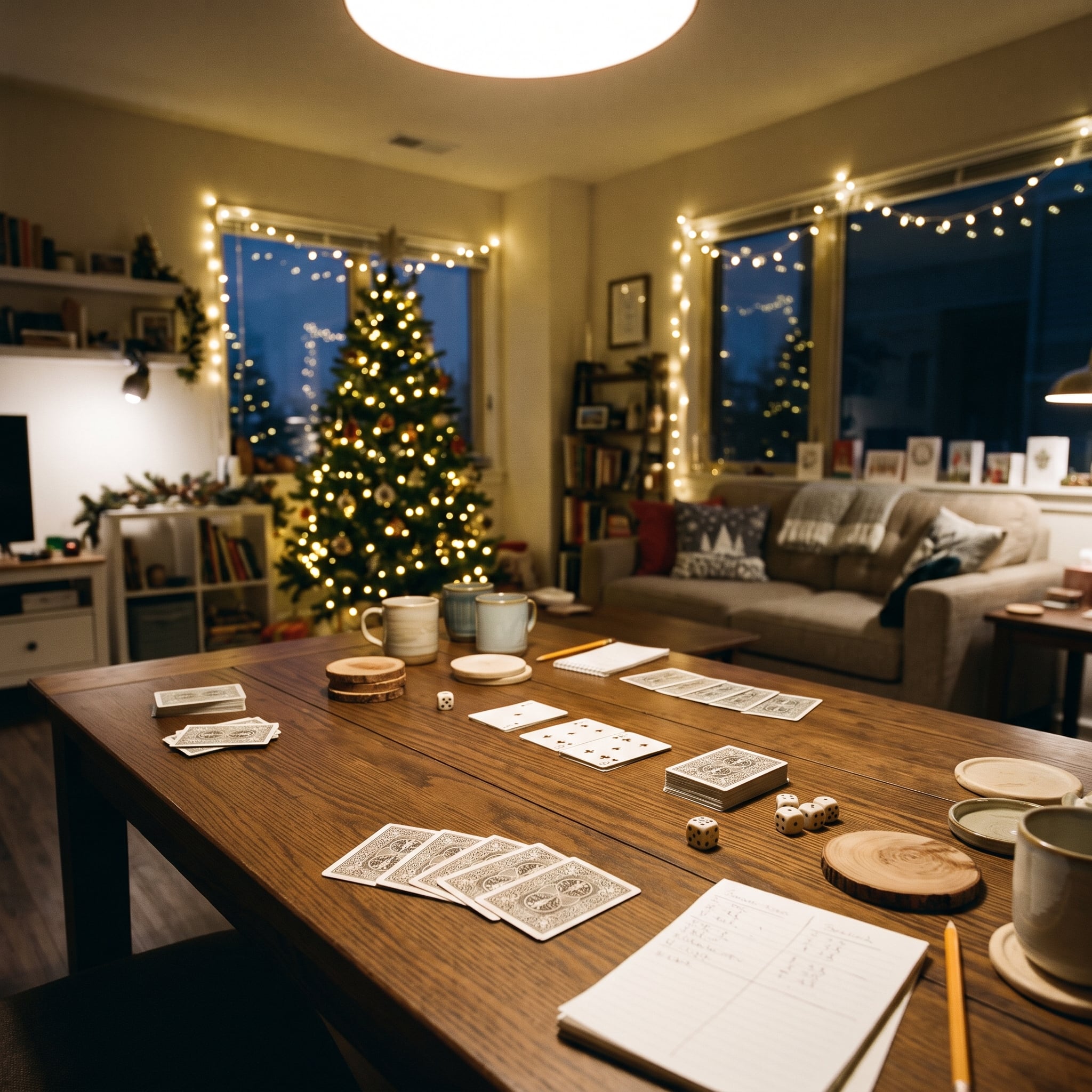
At 6:15, three people are standing beside the snacks. One knows the host from college, another works with the host’s partner, and the third has met nobody in the room. They can all admire the Christmas tree, but the conversation has nowhere obvious to go next.
That is the situation Christmas icebreaker games should solve. A useful opener gives strangers something small to decide or create together, then ends before it feels like a scheduled interview. Guests can contribute without explaining their family traditions, employment, relationships, or personal memories.
Unlike longer party competitions, Christmas icebreaker games should finish before guests begin wondering when the real gathering will start.
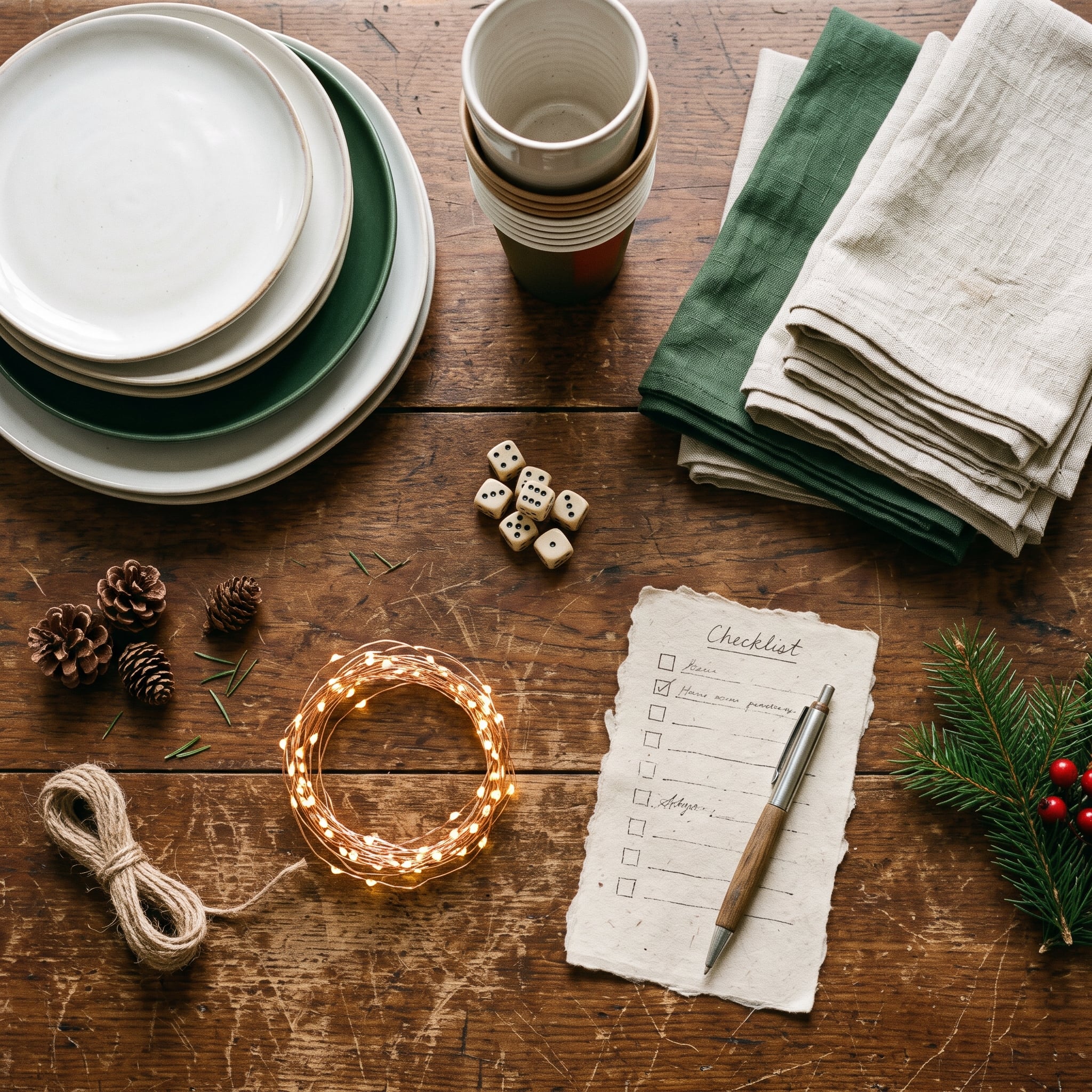
The six activities below use ordinary paper, pens, and optional dice. Each includes a way to begin, a clear stopping point, and an adjustment for guests who prefer to listen. These are holiday-themed house rules created for this guide, not official instructions supplied with any game product.

Choosing Christmas Icebreaker Games for Different Guest Lists
Choose the first activity based on how people will enter the room. A dinner party with six guests arriving together can play in one circle. A house party with fifteen guests coming in waves needs something that can restart without interrupting everyone else.
| Opening Game | Active Players | Supplies | Best Moment | Playing Time |
| Two-Card Welcome | 4–16 | Two large choice cards | While people arrive | 6 min |
| Postcards From Elsewhere | 4–12 | Two bowls of paper slips | Once pairs form | 8 min |
| Gift-Tag Translator | 4–12 | Six fictional gift labels | At the snack table | 8 min |
| Snow Globe Dice Duet | 4–10 | Two dice and a prompt key | Small seated group | 10 min |
| Three-Stop Connection Chain | 6–15 | Paper and pens | Mixed friend circles | 9 min |
| The Recommendation Wall | 4–20 | Sticky notes and a board | Staggered arrivals | 10 min |
For Christmas icebreaker games involving people who have never met, favor questions about imaginary situations or everyday preferences. A favorite snack is easier to discuss than a family’s holiday customs. Plan for two or three participants to pass without having to give a reason.
Some Christmas icebreaker games work best while coats are still being put away; others need everyone seated. Decide which situation you are preparing for before writing prompt cards.
The suggested numbers indicate comfortable arrangements, not strict capacity limits. For twenty guests, create several small activity groups instead of asking everyone to listen to nineteen introductions.
Game 1 — Two-Card Welcome: Make a Choice Before Making Introductions
Players: 4–16, in pairs or small clusters
Equipment: Two cards labeled A and B, a list of two questions
Finish: Two choices and two short exchanges
Write the following questions on a card visible near the entrance:
Choice One: A — Holiday market snacks; B — Homemade cookies.
Choice Two: A — A snowy cabin weekend; B — An evening of city lights.
The cards represent choices, not teams. People may change their answers between questions.
How to Run It
- Once four guests are available, read the first choice aloud.
- Invite everyone to point to A or B. Guests can indicate their preference from where they are standing or seated, keeping the activity informal and easy to join.
- Ask nearby guests to compare what they selected for about a minute. If two people choose differently, they can each explain one appealing detail.
- Reveal the second choice and repeat with a different nearby person if convenient.
- Put the cards aside after six minutes and let the conversations continue independently.
Example: “I’d pick the market because I want hot pretzels” gives another guest an easy follow-up: “Which kind?”
This is one of the Christmas icebreaker games that can begin before everyone has arrived. A new guest can join the second choice without missing a score or needing a recap.
For Christmas icebreaker games involving only the first few arrivals, the host can participate as one of the conversation partners. There is no need to assemble the entire guest list before starting.
Host Adjustment: When people do not want to speak, let them place a token by their preferred card. Watching the results is still participation.

Game 2 — Postcards From Elsewhere: Make Up a Holiday Trip
Players: 4–12, working in pairs
Equipment: Two bowls, six destination slips, six unexpected-item slips, pens
Finish: One postcard sentence per pair
Use imaginary travel situations so nobody needs to talk about trips they can afford, family plans, or places they have visited.
Put these destinations in one bowl: snowy railway platform, mountain bakery, coastal lighthouse, winter garden, crowded town square, and quiet lakeside cabin.
Put these objects in the other: oversized mitten, tiny brass bell, striped umbrella, paper crown, missing suitcase, and wooden spoon.
Rules for the Postcard
- Each pair draws one destination and one object.
- Give them two minutes to invent a postcard message containing both items. Limit the message to twenty words.
- The pair writes the message and places it face down.
- The host mixes the postcards and reads up to three, if the writers are happy to share them.
- Stop after the reading. There is no ranking of whose message is funniest.
Sample combination: Coastal lighthouse + wooden spoon.
Sample postcard: “Greetings from the lighthouse, where a wooden spoon somehow became the town’s official snow shovel.”
The structure makes Christmas icebreaker games collaborative without requesting a personal confession. Someone can suggest the idea while their partner handles the writing.
Christmas icebreaker games built around fictional situations also work when guests come from different countries. They do not require knowledge of the same Christmas movies, celebrities, or childhood traditions.
For larger groups, let every pair create a postcard, but read only a few. Posting them on a board afterward is optional and requires the writers’ agreement.
Game 3 — Gift-Tag Translator: Find a Present for a Fictional Recipient
Players: 4–12, paired
Equipment: Six handwritten gift tags, pens, timer
Finish: Three 90-second rounds
A gift tag normally tells you who receives a package. In this game, it describes an imaginary character with a peculiar problem. The pair must choose an ordinary object that might help.
Six Tags to Prepare
| Recipient | The Odd Situation |
| A reindeer | Keeps misplacing its travel map |
| A snowman | Wants a desk job |
| A tree topper | Is afraid of heights |
| A gingerbread baker | Has run out of measuring tools |
| A winter explorer | Cannot remember which bag is theirs |
| A holiday DJ | Keeps mixing up the playlists |
Rules and Scoring
- Hand each pair one tag, keeping the others in a pile.
- Give pairs ninety seconds to agree on one realistic object and a single sentence explaining its use.
- Each pair submits its object in writing; speaking to the full room is optional.
- Award one point if the suggestion is a recognizable object and the explanation connects it to the fictional problem.
- Exchange tags and repeat until every pair has completed three rounds.
Three points is a perfect score. Multiple pairs may finish with three, and a tie needs no playoff.
A desk calendar for the snowman’s first office job could earn a point. So could a luggage tag for the explorer who mixes up bags.
These Christmas icebreaker games give strangers a harmless puzzle to solve together. They do not need to guess another guest’s actual gift preferences or spend money on presents.
When choosing Christmas icebreaker games for a mixed group, this type of fictional challenge is especially practical: two people who have nothing obvious in common can still debate whether a snowman needs a desk lamp.
Host Note: Accept several plausible answers. The scoring tests whether a pair has made a coherent connection, not whether the host likes the joke.

Game 4 — Snow Globe Dice Duet: Build a Scene From Two Rolls
Players: 4–10, working in pairs
Equipment: Two standard dice, paper, a simple dice-to-scene key
Finish: Two scenes per pair
The dice provide two ingredients for a fictional snow globe. Partners have to fit them into a single sentence. No acting, drawing talent, or holiday trivia knowledge is needed.
Dice Key
| First Die | Place | Second Die | Visitor |
| 1–2 | Mountain cabin | 1–2 | Lost robot |
| 3–4 | Frozen pond | 3–4 | Curious fox |
| 5–6 | Railway station | 5–6 | Runaway suitcase |
Play Two Short Rounds
- Each pair rolls both dice and matches the numbers to one place and one visitor.
- Give them sixty seconds to write a scene containing both.
- Partners can read their sentence or ask the host to read it anonymously.
- Award one point when both assigned elements appear in a coherent sentence.
- Roll again for the second round, then stop. Two points is the maximum.
Example: A four on the first die and a six on the second creates a frozen pond and a runaway suitcase.
“The suitcase slid across the frozen pond while everyone chased it in their boots” earns one point.
For Christmas icebreaker games at a seated table, using two dice keeps the activity moving without requiring guests to reveal anything about themselves. A Classic Strategy Dice Set can supply standard dice, but borrowed dice work equally well.
Keep Christmas icebreaker games involving dice short enough that new guests do not spend their first twenty minutes waiting for a turn. Two quick rounds are sufficient for this format.
If one guest wants to play without a partner, the host can join them or form one group of three. All three contribute to the same two sentences and earn the same team result.

Game 5 — Three-Stop Connection Chain: Build a Make-Believe Winter Outing
Players: 6–15, divided into groups of three or four
Equipment: Paper, pens
Finish: One three-stop route from every group
A shared imaginary outing is easier to plan than a real event involving travel, schedules, or money. Each person adds one stop, and the next person must explain how the outing moves forward.
The Route Rules
Every group imagines it has an empty afternoon in a winter town.
- Player A selects a starting stop, such as a bakery, train station, or bookshop.
- Player B adds a second stop and gives one reason to go there next.
- Player C adds a final stop and explains how the route ends.
- The group writes the three stops in order.
- Give each group three minutes to finish, then invite a volunteer to share just the final route.
Example: Bakery → Bookshop → Rooftop light display.
The group buys a pastry, looks for a winter mystery novel, and finishes by watching the lights.
If a group cannot agree on a stop, use the first reasonable suggestion and move forward. There are no points or elimination rounds.
Among Christmas icebreaker games, Connection Chain works when you want guests from different social circles to collaborate once before joining larger conversations. Each participant has a defined contribution, and nobody is asked to discuss actual travel plans.
With seven participants, use one group of three and one of four. With eight, make two groups of four. Any fourth member can suggest a route name without creating an extra stop.
Game 6 — The Recommendation Wall: Leave a Clue for Someone New
Players: 4–20, including guests who arrive late
Equipment: Sticky notes, pens, three labeled spaces on a board or wall
Finish: One note per person and a five-minute browse
The Recommendation Wall lets guests exchange ideas through handwritten notes, without gathering everyone for a spoken group activity. People contribute a small recommendation that others can use as a starting point for conversation.
Create three headings: Something to Watch, Something to Eat, and Something to Play.
How to Run It
- Invite each willing guest to write one recommendation under any heading.
- Ask them to include a short reason, such as “Cinnamon popcorn — easy to share.”
- Guests may sign with their first name or leave the note anonymous.
- After several notes have appeared, allow five minutes for people to browse and discuss anything that catches their attention.
- Close the activity by leaving the board available; no winner is announced.
Avoid asking people to share private stories, social-media accounts, or contact details. Guests can add an imaginary recommendation if they prefer a playful answer.
This format makes Christmas icebreaker games possible even when arrivals are staggered and a host cannot stop the room for a formal introduction. Someone arriving twenty minutes late can contribute a note and see what earlier guests suggested.
Of the Christmas icebreaker games in this guide, the Recommendation Wall needs the least direct supervision. The host can explain it once and return to greeting people or serving food.
Party Host Tip: Put the board near refreshments, not at the front door. People are more likely to read it while waiting for a drink than while juggling a coat and bag.

A Twelve-Minute Arrival Plan Using Christmas Icebreaker Games
You do not need to play six activities during one party. Most hosts need a single opener and a backup for a different group size.
For a relaxed gathering where guests do not all know one another, this twelve-minute example gives conversations a starting point without holding up dinner.
| Minute | What Happens | Host’s Job |
| 0–3 | Guests settle and find refreshments | Point out the recommendation wall |
| 3–6 | Two-Card Welcome, first choice | Read two simple options |
| 6–9 | Two-Card Welcome, second choice | Invite a fresh exchange |
| 9–12 | Return to snacks and conversations | Put the cards away |
The wall can remain open throughout the evening. If only two guests are ready at minute three, start a two-person conversation around the choice cards and skip the group announcement.
For Christmas icebreaker games before a seated meal, finish the opener before guests are called to the table. Do not leave pairs in the middle of a timed round while food is being served.
If the event is designed around games, follow the opener with a complete tabletop activity. Christmas Party Games for Adults offers a separate set of games with defined scoring and longer rounds.
Adjust Christmas Icebreaker Games for Guests Who Feel Like Outsiders
A newcomer may be the only person who does not recognize an inside joke. Another guest may know the host well but feel uneasy addressing the entire group. The opener should make space for both.
If everyone else already knows each other: Pair established friends with newer guests for a fictional task, but do not assign an unwilling person to act as a social guide. Give both partners the same materials and a shared decision.
If somebody declines: Offer the cards, food, or a place to watch. A pass is a normal choice; no one owes a personal explanation.
If some guests are not celebrating Christmas: Replace Santa- or reindeer-specific prompts with winter markets, food stalls, lights, or fictional journeys. The rules stay intact.
If guests speak different first languages: Keep the written prompts visible and allow pairs to write their answers. Avoid puns and highly localized trivia.
If mobility or hearing makes an activity difficult: Use pointing, paper responses, or seated pairs. No one needs to cross the room, hear shouted instructions, or perform on command.
The practical test for Christmas icebreaker games is whether guests can choose how much to contribute and still understand what is happening. An activity that relies on public embarrassment may get attention, but it is a poor way to welcome unfamiliar people.
What to Prepare and When a Kit Helps
For the six games above, ordinary household materials will do the job. Prepare paper slips, two reusable choice cards, pens, and two standard dice if you plan to play Snow Globe Dice Duet.
If you prefer ready-made components, the Vibe Creator Party Box lists a dice cup, five dice, social challenge cards, tarot cards, and an LED atmosphere light. Its components may support broader conversation activities, but the house rules in this article are not supplied as official games inside that box. Select only prompts appropriate for a mixed guest list.
The Party Night Games collection offers other boxed options, while Icebreaker Games That Actually Get People Talking discusses general conversation-based party formats beyond Christmas.
For Christmas icebreaker games with people who are meeting for the first time, buying extra equipment is less important than choosing prompts that can be answered comfortably. Do not order a large bundle when a pair of dice and a few blank cards already cover your plan.
Featured Pick: If you want reusable components for several types of gatherings, the Vibe Creator Party Box is worth comparing for its listed cards and dice. For this particular six-game guide, however, a DIY setup is sufficient.
Frequently Asked Questions About Christmas Icebreaker Games
Which Christmas icebreaker games work when nobody knows anyone?
Two-Card Welcome and Postcards From Elsewhere give strangers a shared task without asking them to introduce themselves in front of the room. Keep the first exchange short, then let guests decide whether to continue talking.
Are Christmas icebreaker games suitable for adults who dislike party games?
Use an optional format with no public ranking, such as the Recommendation Wall. Guests can contribute a note, browse suggestions, or simply watch. Treat passing as a normal choice.
How many icebreaker activities belong at the start of a party?
One short opener is generally enough. Keep a second activity ready if guests arrive in several waves or the first format does not fit the group. Do not restart an activity while a good conversation is already underway.
Can the games work without buying special cards?
Yes. Handwritten destinations, fictional gift tags, and two ordinary dice cover the six formats. The text supplies the prompts and scoring rules for each one.
What happens if a new guest arrives after the game begins?
Let them join the next short round or add a note to the Recommendation Wall. Avoid requiring everyone to stop and repeat their introductions for each arrival.
How are these different from workplace Christmas team games?
These activities prioritize low-pressure first conversations among strangers or loosely connected friends. A workplace event may need formal teams, equal scoring opportunities, and a shorter scheduled session.
Let the First Conversation Outlive the Game
A fictional postcard might lead two guests to discover they both enjoy train journeys. A choice between market snacks and homemade cookies can start a conversation about cooking. None of that requires a host to announce that everyone has become friends.
The most useful Christmas icebreaker games leave behind a question, a recommendation, or a shared piece of nonsense that people can keep talking about.
End the structured part early, clear the cards when necessary, and leave the next conversation to the guests.