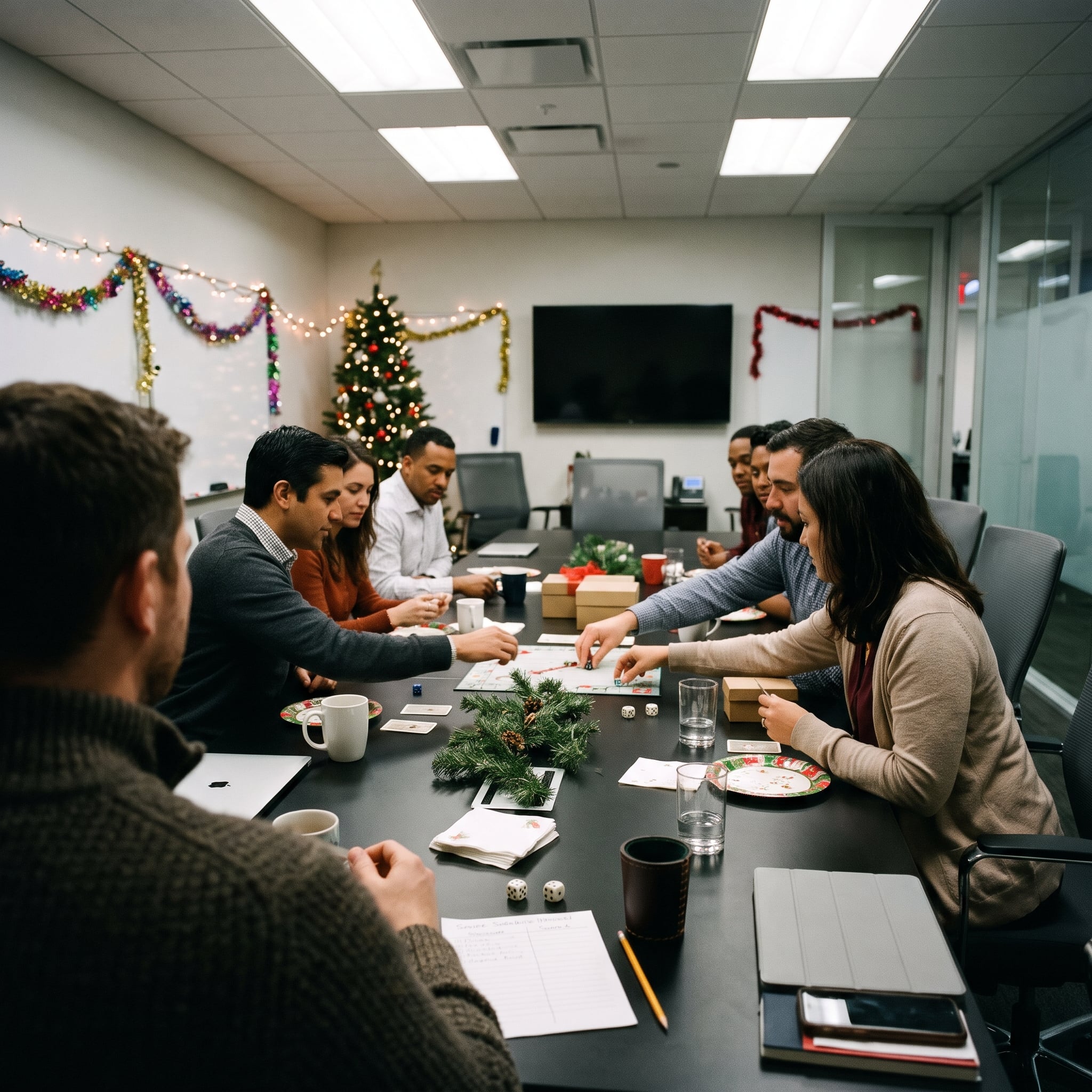
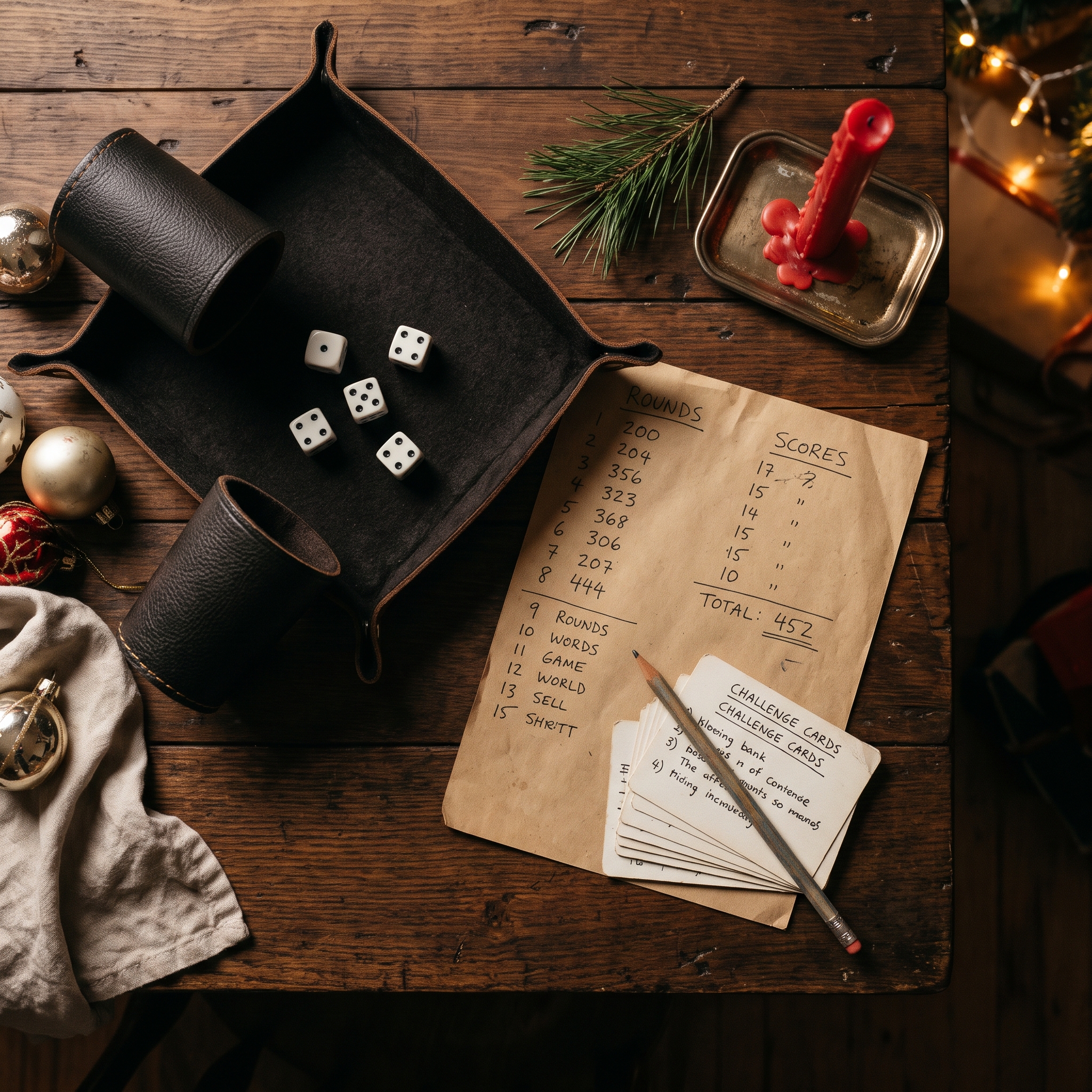
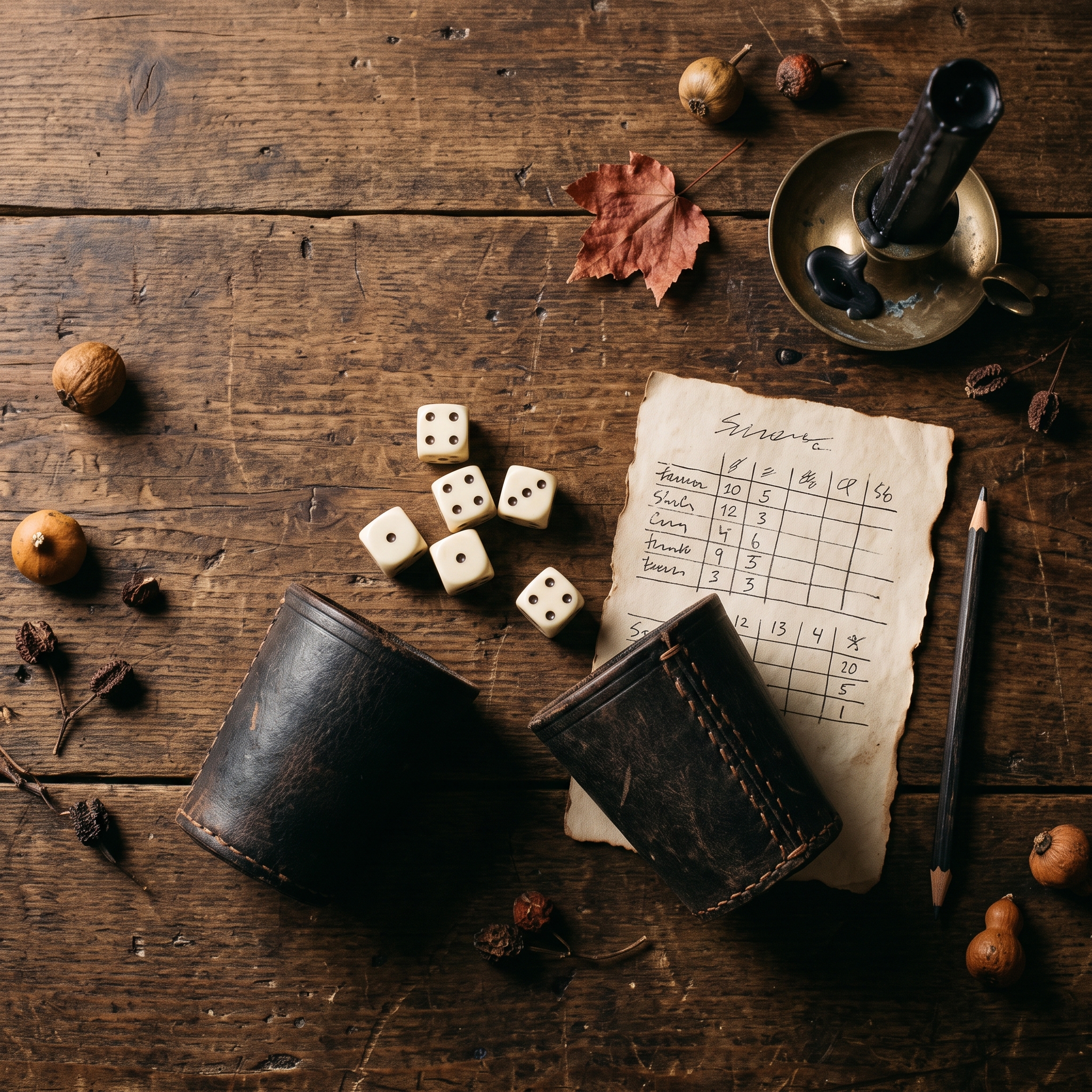
A set of rainbow glasses is sitting beside the cranberry punch, but nobody has decided what the glasses are for. On the other side of the table are five dice, a cup, and a pile of gift tags left over from wrapping presents. That is enough equipment for an entire evening of small challenges—provided the rules are decided before the first roll.
These Christmas drinking games use drinks as part of the holiday ritual, not as a punishment for losing. A “toast” means an invitation to raise a cup; taking a sip is always optional, and every activity works with alcohol-free drinks. The competitive parts are decided through guesses, points, or completed tasks.
Each of the six games below specifies players, equipment, turns, and a finish. Their names and house rules are created for this guide. They are not presented as official rules for commercially branded games.
How to Choose Christmas Drinking Games Without Overcomplicating the Table
Check the number of active players before choosing a format. A group of four can follow an individual dice turn; a room of ten usually benefits from simultaneous guesses or two teams.
| Game | Players | Equipment | Main Decision | Approx. Time |
| Candy Cane Toast Dice | 3–8 | One die, cup, prompt key | Complete a seasonal prompt | 10–15 min |
| Red Cup, Green Cup | 3–10 | Two labeled cups, one die, tokens | Predict odd or even | 5–10 min |
| Stocking Score | 3–6 | Three dice, paper | Keep or reroll a combination | 15 min |
| Winter Menu Match | 3–8 | Four labeled drinks, prompt cards | Guess another player’s pairing | 10–15 min |
| Jingle Jury | 4–10 | Pens, anonymous answer slips | Identify who wrote a response | 15 min |
| Final Toast Bingo | 4–12 | Bingo cards, pens | Complete a row of holiday moments | 15–25 min |
The times are planning estimates. None requires anyone to finish a glass before taking the next turn.
These Christmas drinking games work best with a small drinks station beside the game table. Keep water, alcohol-free choices, napkins, and clearly labeled beverages available so that nobody needs to leave a round just to find an alternative.
Game 1 — Candy Cane Toast Dice: A Holiday Conversation Challenge
Players: 3–8
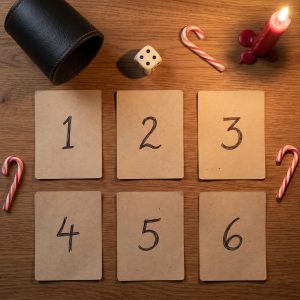
Equipment: One standard die, an optional dice cup, the six-prompt key below
Winning Condition: The most completed prompts after three turns per player
A die selects the conversation challenge. It never selects a quantity of alcohol.
| Die | Seasonal Prompt |
| 1 | Name a holiday food you would defend in a friendly argument |
| 2 | Choose a Christmas movie to rewatch tonight |
| 3 | Give a one-sentence toast to someone at the table |
| 4 | Name an awkward gift you would secretly enjoy |
| 5 | Recommend a song for the next ten minutes |
| 6 | Choose two people to invent a fictional reindeer name |
How a Turn Works
- The starting player rolls one die and reads the matching prompt.
- They have up to 30 seconds to answer or complete it. On a six, both nominated players each contribute one word.
- Completing the prompt earns one point; passing earns zero.
- Move clockwise. Everyone receives three turns, even if a player reaches three points early.
After each complete circuit of the table, the host may invite a brief toast. Guests can raise whichever drink they have, sip voluntarily, or simply join the words.
Example and Tiebreaker
A roll of three asks for a one-sentence toast. “To the friend who brought extra napkins before we knew we needed them” earns one point. Another player may answer a different prompt without needing to drink.
If two players finish with three points, give each a final roll. The quickest valid response wins. If both answer within the time limit, share the win.
Among Christmas drinking games, this is an accessible opening option when several guests have not met. The written die-to-prompt key also prevents disputes about what a number means.
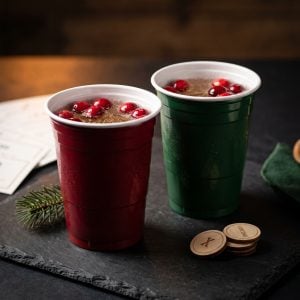
Game 2 — Red Cup, Green Cup: A Two-Choice Prediction Game
Players: 3–10
Equipment: Two cups labeled RED and GREEN, one die, one token per player, score paper
Winning Condition: Most correct predictions after six rounds
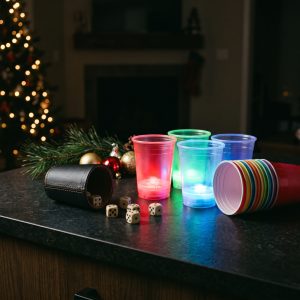
The two cups are voting stations, not containers of different-strength drinks. LED cups can make the stations easier to identify in a softly lit living room; paper labels work just as well.
How to Play
- Assign RED to odd die results (1, 3, 5) and GREEN to even results (2, 4, 6).
- Before each roll, all players place their token beside one of the two cups.
- Once everyone has chosen, the dealer rolls the die in the center.
- Each correct prediction scores one point.
- Retrieve the tokens, pass the dealer role clockwise, and repeat for six rounds.
Players may pick the same cup. No player is eliminated.
Example and Ending
Five people choose RED; three choose GREEN. The die lands on four. The three GREEN voters each score one point.
At the end, the highest score wins. For a tie, each tied player makes a new choice and the dealer rolls again until their scores differ.
Use the glasses to mark the teams’ choices and to hold separate water or other beverages if desired. The score is determined by the die, not by who drinks first.
For Christmas drinking games with guests moving between the kitchen and sofa, simultaneous predictions avoid a long wait between individual turns.
Game 3 — Stocking Score: Keep or Reroll
Players: 3–6
Equipment: Three standard dice, dice cup, scoring sheet
Winning Condition: Most points after four turns per player
Stocking Score uses a simple press-your-luck choice. Each player can keep a promising roll or take one chance to improve it.
Score the Three Dice
| Result | Points |
| Three of a kind | 5 |
| One pair, with a different third die | 3 |
| Three different numbers | 1 |
Only the final three-dice result counts. The numerical total of the pips does not affect the score.
How to Play
- Roll all three dice.
- Look at the current pattern and decide whether to keep it.
- Alternatively, select any number of dice to reroll once; the kept dice remain unchanged.
- Score the final result using the table.
- Record the points and pass the dice. Continue until everybody has taken four turns.
A player can skip the optional reroll. No third roll is allowed.
Worked Round
Ava rolls 4, 4, 2, worth three points. She keeps the two fours and rerolls the third die. It lands on four, creating three of a kind and earning five points.
Had it landed on six, she would still have a pair and receive three points. If she rerolled all three dice, she would be risking the existing pair.
The highest total after four turns wins. Tied players each take one bonus turn using the same scoring rule; repeat if necessary.
These Christmas drinking games can use a shot-glass set for candy counters or score markers, but the game has no drinking penalties. A round-ending toast can happen separately, only if the group wants one.
Game 4 — Winter Menu Match: A Holiday Drink-Pairing Challenge
Players: 3–8
Equipment: Four clearly labeled beverage options, small cups if tasting, paper and pens
Winning Condition: Correctly predict the most drink pairings chosen by other players
This game is a comparison of preferences, not a blind-tasting challenge. Every beverage and ingredient should be labeled, and nobody needs to taste anything to play.
Prepare four options such as cranberry spritz, ginger soda, sparkling apple drink, and peppermint cocoa. Alcohol-free versions are perfectly suitable. Write the same four names on a card where everybody can read them.
How to Play
- Choose one player to be the Menu Maker.
- Read the pairing question: “Which of these four drinks would you choose with gingerbread?”
- The Menu Maker secretly writes one choice.
- Everyone else predicts the Menu Maker’s answer.
- Reveal the choice. Each matching prediction earns one point.
- Rotate the Menu Maker role; use a different snack pairing for each round.
Use the following snack prompts in sequence: gingerbread, salted pretzels, cinnamon cookies, cheese crackers, orange slices, and dark chocolate.
If there are more than six players, repeat a prompt. The subject is each person’s preference, so there is no single correct pairing.
Complete one Menu Maker turn per player. The highest score wins; tied players share the result.
Why the Drinks Matter
Guests who wish to can sample a labeled drink after voting, but the tasting does not affect scoring.
This format puts the seasonal drinks themselves at the center of Christmas drinking games without creating a contest over consumption.
Use separate serving utensils and disclose ingredients, particularly for dairy, nuts, and other allergens. The host can also present printed drink names without serving samples at all.
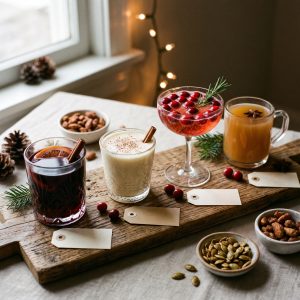
Game 5 — Jingle Jury: Who Wrote the Gift Tag?
Players: 4–10
Equipment: Small blank cards, pens, bowl, one numbered score sheet
Winning Condition: Most correct author guesses after two prompts
Jingle Jury works for friend groups that enjoy playful comments but do not want public dares.
Prepare Two Prompts
Write these on separate slips:
- “The most useful thing Santa could leave at my door would be…”
- “My imaginary job at the North Pole would be…”
How to Play
- Each player writes one anonymous answer to the first prompt and folds it.
- The host shuffles all answers in a bowl.
- The host reads each answer aloud and numbers it.
- Players privately write one author guess beside each answer number. They cannot select themselves as the author.
- Reveal who wrote each answer.
- Earn one point for every correct guess; no points are awarded for one’s own response.
- Repeat with the second prompt.
At the end of both prompts, the highest score wins.
If tied, use a third prompt: “I would replace the office Christmas party with…”. The tied players make author guesses for that round, and the highest bonus score wins; repeat if needed.
Pair It With a Toast, Not a Penalty
The writers of the funniest answers can be invited to lead a group toast, but accepting is optional. No one needs to reveal a real secret or explain an uncomfortable story.
Because everyone answers at the same time, Jingle Jury is one of the Christmas drinking games that can include a larger circle without leaving most guests idle.
Game 6 — Final Toast Bingo: A Game That Follows the Party
Players: 4–12
Equipment: One 3×3 bingo grid per person, pens, optional drinkware
Winning Condition: First player to complete a horizontal, vertical, or diagonal row
This final game turns small moments around the gathering into a shared activity. The goal is to notice what people say or do during ordinary conversation, not to demand that they consume anything.
Prepare a Nine-Square Card
| Someone mentions a holiday movie | Someone recommends a December song | A guest offers to help with food |
| Someone talks about a past trip | A guest proposes a toast | Someone compliments a dish |
| Someone chooses an alcohol-free drink | Two people discover a shared favorite food | Somebody asks for another game |
Everyone receives the same grid. Only events observed after the game begins count.
How to Play
- Give every player a grid and explain the nine conditions.
- Start a 20-minute observation period.
- Players mark an event only after it occurs naturally; they may not directly ask someone to perform an action just to complete a square.
- The first player to mark a full line announces “Bingo.”
- At the end of the round, the group confirms the marked events.
If two people finish at the same moment, share the win. If nobody completes a line after 20 minutes, the player with the most marked squares wins; ties stand.
The toast square is satisfied when someone offers a toast, even if no one drinks. The alcohol-free square does not require anyone to justify a choice.
Among Christmas drinking games, Final Toast Bingo is a softer finish for a group that is ready to return to conversation.
Christmas Drinking Games for Different Group Sizes
The best game depends on how many people are actively playing, not just how many were invited.
For 3–4 players, Candy Cane Toast Dice and Stocking Score keep everyone involved. One dice cup is sufficient.
For 5–8 players, Red Cup, Green Cup and Winter Menu Match allow everyone to submit a decision in the same round. They also work when guests prefer different types of drinks.
For 9–12 players, Jingle Jury and Final Toast Bingo avoid the slow rotation of a single dice cup.
| Group Situation | Best Starting Game | Follow-Up |
| Three friends at a small table | Stocking Score | Candy Cane Toast Dice |
| Six guests with mixed drink preferences | Winter Menu Match | Red Cup, Green Cup |
| Eight friends who enjoy conversation | Jingle Jury | Candy Cane Toast Dice |
| Ten or more moving between rooms | Final Toast Bingo | Two smaller game tables |
These Christmas drinking games do not require guests to stay at one table for hours. Choose a fresh-match format if people are expected to arrive late or leave early.
Which Equipment Fits Christmas Drinking Games?
All six formats can be played with everyday household supplies. A dedicated kit is useful when it provides the correct dice quantity, cups, or lighting accessories rather than duplicating things you own.
The Drinking Dice Starter Kit includes one dice cup, five regular dice, and a six-piece Rainbow Shot Glass Set. Its dice work for Candy Cane Toast Dice and Stocking Score; the glasses can hold score counters or separately labeled drinks.
For smaller illuminated setups, the LED Party Drinking Game Set for Adults includes one dice cup, five dice, two LED cups, and twelve rainbow shot glasses. The two illuminated cups can represent RED and GREEN in the prediction game, without using light colors to assign drinking penalties.
For a larger party, the Ultimate Drinking Night Bundle contains two dice cups, ten dice, an LED ice bucket, four light-up cups, and twelve rainbow shot glasses. Two sets of dice are handy when groups play at different tables.
The full Drinking Party Games collection provides additional context on available kits and their components. Before choosing a kit, compare its listed contents with the dice, cups, and accessories required for your planned games.
Featured Pick: For Christmas drinking games centered on a table with three to six friends, the LED Party Drinking Game Set offers a direct equipment match to the colored-cup activity described above. It is a recommendation based on the published contents, not a claim of hands-on product testing.
Set the Drink Rules Before the Game Rules
The easiest way to avoid an uncomfortable moment is to make participation terms clear before anyone takes a seat.
All six Christmas drinking games use points to determine winners. No one earns a penalty drink for losing, and no rule demands that a person finish a glass, take repeated shots, or drink on a timer.
Set out water, alcohol-free options, and food. Let guests decline a toast or stop playing without explanations. Only adults of legal drinking age should be served alcohol; anyone who is pregnant, taking medications that interact with alcohol, planning to drive, or simply choosing not to drink should have a full place in the games without it.
Do not use surprise ingredients or unlabeled tasting cups. Keep track of whose glass is whose, and replace shared sample cups with individual ones when tasting options are offered.
With these boundaries, Christmas drinking games remain social activities rather than tests of endurance. The host can still decorate the table with shot glasses or an LED bucket without making alcohol the focus of competition.
Common Problems During a Holiday Drink Game
Someone arrives in the middle of a round. Let them watch until the next fresh match. For Bingo, give them a new blank card and a new observation window rather than letting them inherit another player’s marks.
A drink is spilled over the score sheet. Move beverages away from the center of the playing surface, dry the table, and restart only the affected turn if the outcome cannot be reconstructed.
The dice fall off the table. Count only flat, visible results on the playing surface. Reroll an invalid die individually.
The game takes longer than expected. Agree on a shorter round count before starting a fresh match. Do not change the finish after a leader has emerged.
A guest doesn’t want alcohol. Nothing about the scoring needs changing. Give them the same prompt, token, or prediction card used by everybody else.
Two groups want different games. Put the dice challenge at one table and an anonymous-card game at another. Give each station its own score sheet.
These details help Christmas drinking games continue without requiring the host to negotiate new rules after every interruption.
Frequently Asked Questions About Christmas Drinking Games
What are easy Christmas drinking games for three or four adults?
Candy Cane Toast Dice and Stocking Score are compact choices. The first needs one die and a prompt list; the second needs three dice and a score sheet.
Can Christmas drinking games work without alcohol?
Yes. The six house-rule games here determine results through dice, guesses, and completed tasks. Mocktails, soft drinks, or water can replace alcoholic beverages, and a guest may skip the drink entirely.
Do I need Christmas-themed dice or special shot glasses?
No. Regular six-sided dice, ordinary cups, paper, and pens are enough. LED cups and rainbow glass sets are optional accessories.
Which game works for ten people?
Jingle Jury and Final Toast Bingo support a larger number of simultaneous participants. They avoid requiring ten separate dice turns before the group can move on.
Can I combine these games with a general Christmas party?
Yes. Choose one activity before or after dinner and keep the remainder optional. For seven additional non-drinking-focused games, see Christmas Party Games for Adults.
How many games should I prepare?
Two is often sufficient: a short opening round and a second choice for later. Extra equipment is useful only when several tables will play at the same time.
Give the Cups a Purpose Beyond the Pour
A glass can indicate a vote. A dice cup can hide a roll. Rainbow shot glasses can hold colored counters. And a toast can mark the end of a round without becoming a requirement to drink.
That flexibility is what makes Christmas drinking games easy to adapt to an adult holiday gathering with different personalities and drink preferences.
Select the rules first, check the supplies, and decide where guests can join or leave a round. Then keep the beverage choices open and let the points—not the number of sips—decide who wins.